Distinguish fluency from reliability
Explain why confident, detailed or persuasive AI-generated language does not by itself demonstrate accuracy, evidence or understanding.




 Understanding Academy
Erasmus+ Courses for Teachers and Educators
Erasmus+ teacher training course
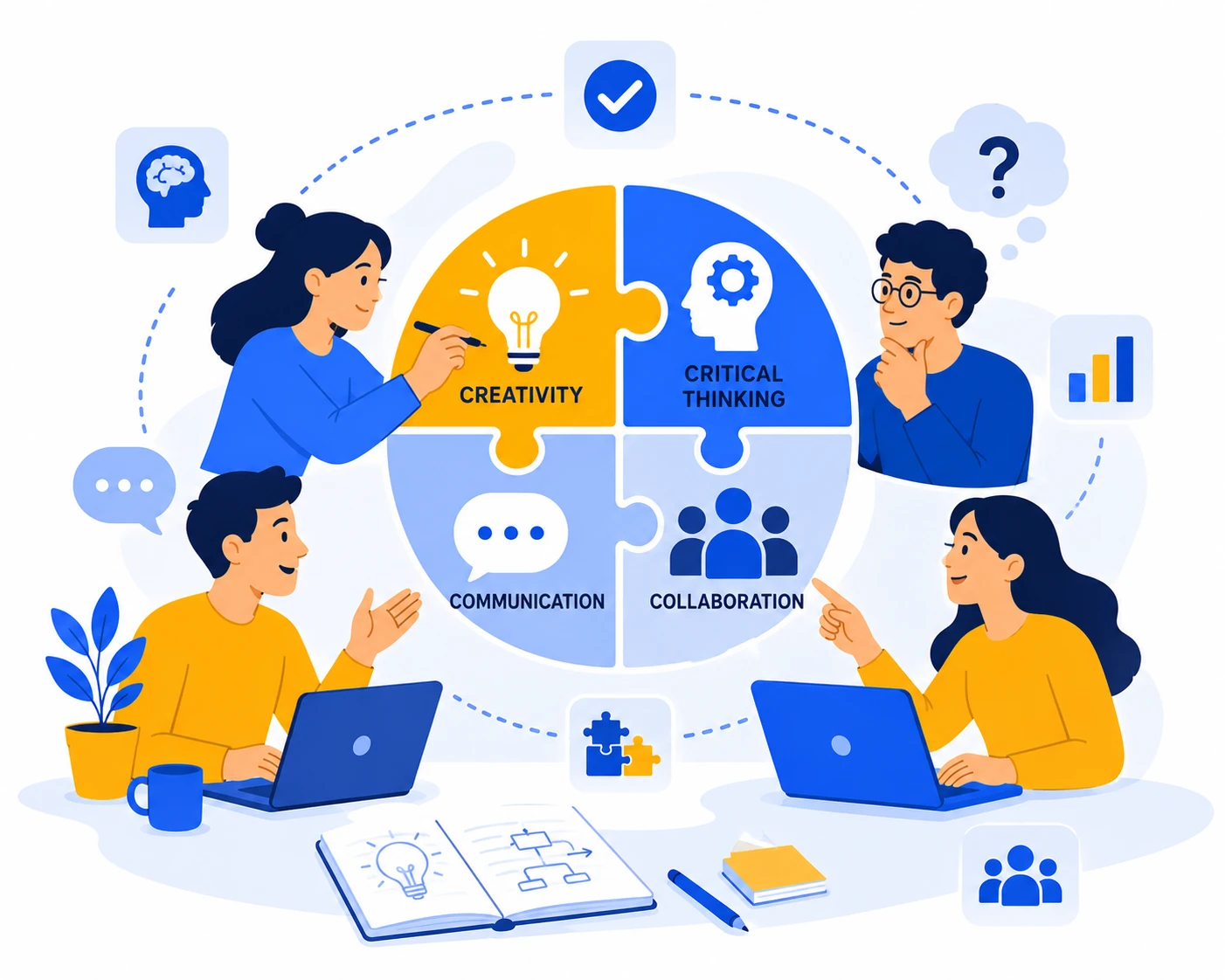
How can educators turn confident AI outputs into opportunities for investigation and critical thinking?
Help learners question, compare and verify generated content instead of accepting it as an answer.
Target group: Teachers, adult educators, trainers, curriculum coordinators, school leaders and other education professionals from all educational levels.
AI-generated information can sound convincing even when it contains weak arguments, invented sources or missing context. Instead of treating AI only as a tool for producing answers, this course uses its output as material for investigation. Participants learn how AI can create opportunities for learners to question, compare and make informed decisions.
Practical activities focus on separating claims from evidence, checking sources, comparing different accounts and looking beyond generated citations. Participants examine bias, uncertainty, privacy and the limits of automated answers. They also explore how to build a classroom culture where learners explain their reasoning, recognise when evidence is weak and feel able to change their opinion.
Each participant designs and tests a learning sequence in which learners question AI-generated material, check evidence, record their reasoning and use human judgement to reach a supported conclusion.

Learning outcomes
Explain why confident, detailed or persuasive AI-generated language does not by itself demonstrate accuracy, evidence or understanding.
Break an AI response into claims, assumptions, omissions and uncertainties, then formulate questions that require further investigation.
Use source tracing, lateral reading and claim-evidence comparison to determine whether external evidence genuinely supports a generated statement.
Create learning sequences that require independent thought, purposeful AI interaction, documented reasoning and revision rather than passive acceptance or copying.
Define appropriate boundaries for privacy, accuracy, bias, transparency, intellectual property and professional accountability when using AI in education.
Six-day programme
Participants examine an instructor-created AI response, record their immediate reaction and then identify which parts are claims, interpretations, recommendations or unsupported assertions.
Participants compare outputs that differ in tone, detail and certainty, then discuss how polished language, references and technical vocabulary can influence perceptions of reliability.
Small groups divide a generated answer into individual claims and mark what appears verifiable, uncertain, value-based, incomplete or dependent on missing context.
Participants compare responses produced from variations of the same question and identify how wording, context, role instructions and requested format influence what appears in the answer.
Participants examine whose perspectives, experiences, evidence or possible consequences are absent from an output and rewrite the inquiry to expose those gaps.
Participants create a transparent record showing the original purpose, information supplied, prompt changes, generated outputs and decisions made by the human user.
Participants investigate a set of instructor-created outputs containing reliable, weak, irrelevant and invented citations, then determine whether each source exists and supports the associated claim.
Participants leave the original page or generated answer to investigate authorship, publication context, independent coverage and evidence from other sources.
Teams create a concise record connecting each important claim with its supporting source, evidence strength, unresolved questions and degree of confidence.
Participants examine an apparently convincing AI-generated argument and identify vague authority, false balance, unsupported causation, selective evidence and rhetorical shortcuts.
Participants ask what evidence could challenge a generated conclusion, build the strongest reasonable alternative and decide whether the original position should be retained, qualified or rejected.
Participants discuss situations in which AI assistance may be appropriate, questionable or unsuitable and justify where human expertise, care or accountability must take priority.
Participants redesign an activity so learners form an initial interpretation, prediction or solution before consulting an AI system.
Participants introduce checkpoints that require comparison, explanation, disagreement, source verification or revision instead of allowing a generated answer to end the learning process.
Participants identify evidence of learning beyond the final product, including question development, source choices, revisions, oral explanation, uncertainty and justified disagreement.
Course foundations
Completing the course
Learning is supported throughout the week through participation, reflection, practical activities and constructive feedback.
Learning approach
The course combines hands-on workshops, real-world examples, simulations, guided reflection and collaborative activities. Participants exchange good practices, work in international groups and develop ideas that can be adapted to their own professional context.
Optional cultural, social and networking activities support local engagement, intercultural learning and professional collaboration.
Before you travel
One week, normally comprising 25 academic hours.
Classes take place from Monday to Friday, in the morning or afternoon. Saturday is reserved for cultural activities.
The detailed timetable will be sent at least two weeks before the beginning of the course.
No special preparation is required unless stated in the course programme. Any required materials or equipment will be communicated before the course.
Participants who meet the attendance requirements receive a Certificate of Attendance.
The standard fee is €480. See what the course fee includes.
Alternative arrangements: Other course durations and schedules may be arranged on request.
Erasmus+ funding: Course fees and mobility costs may be supported through an eligible sending organisation's Erasmus+ grant. Eligibility and final funding decisions remain with the beneficiary organisation and its National Agency. Read our Erasmus+ KA1 funding guide.
Administrative support: Understanding Academy provides course programmes, learning outcomes, registration documentation and certificates. Participants and sending organisations remain responsible for transport, accommodation and grant management.
Plan your Erasmus+ mobility
Check the upcoming confirmed dates or register your interest. We will contact you with information about availability and the next steps.
Need funding information? Read our Erasmus+ KA1 funding guide.