Explore 22 original paths
Choose structured activities for observation, interpretation, connection, reflection, dialogue and action planning.


 Understanding Academy
Erasmus+ Courses for Teachers and Educators
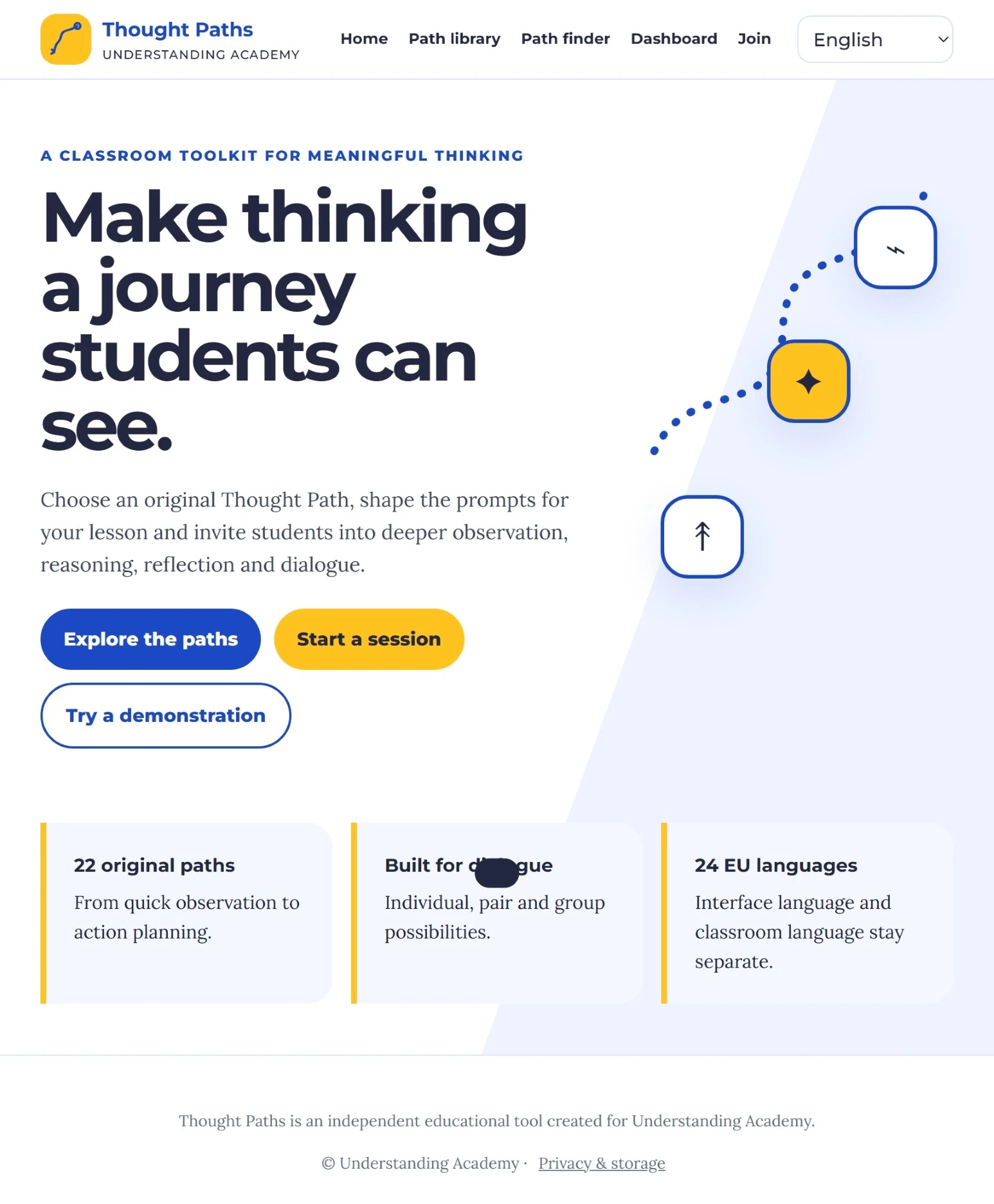
Follow interactive paths inspired by thinking routines. Explore ideas, make connections, reflect on different perspectives and turn thinking into meaningful dialogue.
Free and unlimited access for educators.
Make thinking visible
Thought Paths helps educators guide learners through structured processes of observation, questioning, connection, interpretation, reflection and dialogue. Each path provides a clear purpose, carefully sequenced prompts and practical guidance for using it with learners.
The resource is inspired by thinking-routine approaches but offers an original collection of interactive paths created for flexible educational use. Educators can select a path directly or use the Path Finder to identify an appropriate activity for a particular learning goal, lesson stage, group or available amount of time.
Choose structured activities for observation, interpretation, connection, reflection, dialogue and action planning.
Use the Path Finder to receive recommendations based on your learning goal, lesson stage, time, group and learning material.
Adapt the prompts for individual reflection, pair work, group discussion or whole-class dialogue.
Start an interactive activity or print a path as a practical worksheet for use away from the screen.
Browse the path library or use the Path Finder to identify a suitable thinking process.
Guide learners through the prompts individually, in pairs or as part of a collaborative group.
Compare interpretations, explore different perspectives and turn individual thinking into meaningful dialogue.
Review the learning process and consider how ideas, assumptions or perspectives have developed.
Free educational resource
Request free access and use the paths whenever you need to guide reflection, deeper learning or meaningful dialogue.